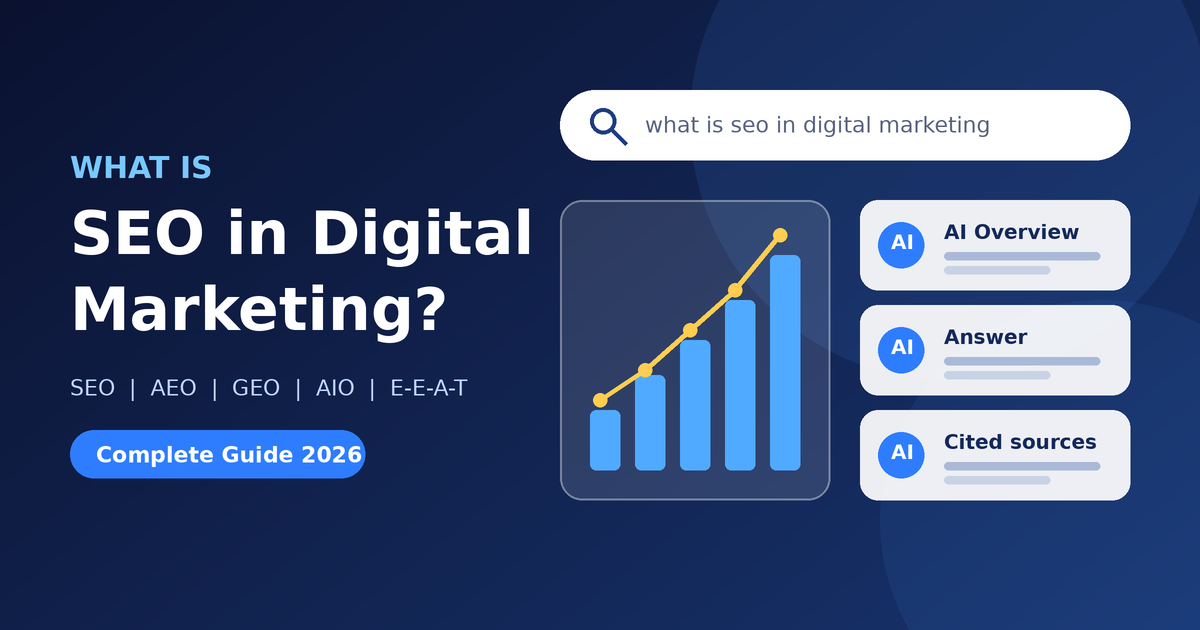
What Is SEO in Digital Marketing? A Complete Guide to Search Engine Optimization
Key Takeaways
SEO helps search engines and AI tools find, understand, and trust your website, so the right visitors reach you organically.
Google says AI Overviews need no special optimization, so SEO fundamentals still power AEO, GEO, and AIO.
E-E-A-T is not a ranking factor, but trust is the signal Google values most.
Google ran two core and four spam updates in 2026, so quality and spam compliance matter all year.
A strong SEO plan combines technical SEO, intent-led content, and authority building, tracked monthly.
Every day, people type a question into Google, ask an AI assistant for a recommendation, or use voice search, and then pick from the handful of answers they see. If your business is not one of them, you lose the customer before they ever reach your website. That is the problem SEO solves.
So, what is SEO in digital marketing? It is the practice of improving your website and content so search engines and AI answer tools can find, understand, and trust them, which brings qualified visitors to you without paying for every click. In this guide, we explain how search engine optimization works today, how AEO, GEO, AIO, and LLMs change the picture, what Google's recent algorithm updates mean for your site, and how to build an SEO plan you can actually run.
What Is SEO in Digital Marketing?
SEO stands for search engine optimization. Inside a digital marketing strategy, it is the channel that earns visibility in organic (unpaid) search results. Google describes SEO as work that helps search engines discover and understand your content and says it is most useful when applied to people-first content. Its SEO Starter Guide is a good free reference for the basics.
Paid ads buy speed. SEO builds a compounding asset: a page that ranks and earns trust keeps working after the campaign budget is gone. A mature plan uses both, but SEO is usually the channel that lowers your cost of acquiring a customer over time.
SEO rests on three pillars:
Technical SEO: making your site crawlable, fast, secure, and easy to index.
Content SEO: answering real questions with depth, original insight, and clear structure.
Authority SEO: earning links, mentions, reviews, and brand signals that prove you can be trusted.
SEO also lifts every other channel. Social posts, email, and paid campaigns all send people to a website, and an optimized site converts that traffic better. That is why our search engine optimization service works alongside social media marketing and website development. If you are still weighing whether a site is worth the investment, read why a website drives business growth. Whether you serve Riyadh, Dubai, London, or New York, the principles are the same. If you are comparing providers, our guide to organic SEO services, agencies, and pricing in Saudi Arabia shows what to expect.
How Search Works Now: Google, AI Answers, and LLMs
Search is no longer ten blue links. Google's AI Overviews and AI Mode summarize a topic and attach supporting links. Google says both may run several related searches across subtopics to build one response, which is why a single page can now be cited for questions it never targeted directly. Meanwhile, assistants built on large language models (LLMs) such as ChatGPT, Gemini, Perplexity, and Claude retrieve and cite web pages too.
This created new labels. They sound technical, but each one has a simple job:
Term | Stands for | Goal | What to do |
SEO | Search Engine Optimization | Rank in classic search results | Fix technical health, publish helpful content, earn links |
AEO | Answer Engine Optimization | Be the direct answer in featured snippets, voice search, and AI answers | Lead each section with a short answer, use question headings, add a real FAQ |
GEO | Generative Engine Optimization | Be cited or mentioned in AI-generated answers | Publish original data and expert views, keep brand facts consistent, cite credible sources |
AIO | AI Overviews optimization (also used for AI optimization in general) | Appear as a supporting link in Google AI Overviews | Keep pages indexed, snippet-eligible, and genuinely helpful |
LLMs | Large language models | The engines behind AI assistants | Make content easy to retrieve and quote, and allow the crawlers you want |
The most important point is also the most reassuring. Google states that there are no additional requirements to appear in AI Overviews or AI Mode, and no special optimizations are necessary. A page only needs to be indexed and eligible to show with a snippet. Google also says you do not need new machine-readable files, AI text files, or special schema markup. In other words, AEO, GEO, and AIO are not replacements for SEO. They are SEO done with sharper answers and stronger proof.
Here is how to apply that in practice:
Answer first. Put a direct 40 to 60 word answer right under each heading, then add depth.
Use question-style headings. Match the way people phrase prompts to AI tools and voice assistants.
Keep key content as text. Google lists making sure important content is available in textual form as a best practice, so avoid hiding it inside images or scripts.
Match structured data to the page. Markup must reflect what visitors can actually see.
Keep brand facts consistent. Use the same name, services, and location details across your site, Google Business Profile, LinkedIn, and directories.
Do not block crawlers by accident. Check robots.txt and your CDN or hosting rules, which Google also flags.
Publish something original. Case data, your own testing, and expert commentary give AI systems a reason to cite you instead of a competitor. Our SEO case studies show how we document that kind of evidence.
You can measure results too. Google reports AI feature traffic inside the Search Console Performance report under the Web search type, so you do not need a separate tool to start. For more on this topic, read Google's guide to optimizing for generative AI search.
E-E-A-T and the Latest Google Algorithm Focus
E-E-A-T stands for experience, expertise, authoritativeness, and trust. Google explains that E-E-A-T is not a specific ranking factor, but its systems use a mix of signals that point to content with strong E-E-A-T. Of the four, trust is the most important, and topics that affect health, money, safety, or well-being (called YMYL) get even more weight. Google's quality raters use the Search Quality Evaluator Guidelines to judge this, though their ratings do not directly change rankings.
Google suggests asking "Who, How, and Why" about every page. You can build that into your content like this:
Who: Add a visible author byline that links to a bio with real credentials. Never use made-up authors or AI-generated headshots, which Google treats as deception.
How: Explain how the content was produced, including any tested products, data sources, or AI assistance where readers would reasonably expect it.
Why: Create content to help people first, not to chase rankings.
Proof: Show first-hand work such as case studies, screenshots, and named sources. Add clear About and Contact pages.
Google Updates in 2026 So Far
Google's ranking changes this year have come in two forms: broad core updates and spam updates. Here is the log, newest first, as of 13 October 2026.
Dates (2026) | Update | Length | What to know |
24 September to 8 October | 14 days | Fourth spam update of the year, global, all languages. Google shared no policy changes | |
18 to 21 August | About 2.5 days | Global, all languages | |
24 to 26 June | June spam update | About 2 days | Landed weeks after the May core update |
21 May to 2 June | 12 days | Second core update of 2026, not a penalty | |
27 March to 8 April | 12 days | First core update of 2026 | |
24 to 25 March | March spam update | Under 20 hours | Preceded the March core update |
Google described both core updates as regular updates meant to surface relevant, satisfying content from all types of sites. They are not penalties and not manual actions. Spam updates are different: they improve the systems that detect content and tactics that break Google's spam policies. Google also says that using automation or AI mainly to manipulate rankings counts as scaled content abuse.
As of today, the May update is the most recent core update we found, and industry watchers expect another one. Here is what to do about it:
Do not rewrite your site in a panic mid-rollout. Wait at least one full week after an update finishes before judging Search Console data.
Compare traffic against the exact rollout dates to separate the update's effect from normal fluctuation.
Audit pages that dropped using Google's people-first content questions, not a one-off recovery trick. No single fix is tied to one update.
Remove thin, mass-produced, or unedited AI pages. Invest in original effort, accuracy, and expert review instead.
The pattern is consistent: Google keeps tightening the same screw. Helpful, original, well-sourced content from a trustworthy site wins over time, and spam gets filtered out faster.
SEO Content Strategy and SEO Plan You Can Run
An SEO content strategy decides what you publish, for whom, and how each page supports a business goal. An SEO plan turns that strategy into dated tasks. You need both, because content without a plan stalls and a plan without strategy produces busy work.
Build Your SEO Content Strategy in Seven Steps
Map search intent. Sort target queries into informational, commercial, transactional, and local intent, and decide which page type serves each one.
Assign one primary keyword per URL. This prevents keyword cannibalization. In our SEO case study for a UK floral eCommerce brand, a site architecture and category restructuring plan was used to resolve exactly this problem.
Build topic clusters. Pair one pillar page with six to ten supporting articles, linked both ways with descriptive anchor text.
Write answer-first. Open each section with a direct answer, then add depth, examples, and proof.
Add experience and evidence. Include case data, screenshots, expert quotes, and a named author with a bio page.
Link internally with purpose. Send readers from articles to the matching service page, and from service pages back to supporting guides.
Refresh and distribute. Update statistics quarterly, change the visible date only when the content changes substantially, and share each post through email and social media marketing.
A 90-Day SEO Plan
Use this week-by-week plan as a starting point and adjust it to your site size.
Weeks | Focus | Key tasks | Tools |
1 to 2 | Audit and baseline | Verify Search Console and GA4, crawl the site, list indexation errors, record current rankings, clicks, and conversions | Google Search Console, GA4, Screaming Frog |
3 to 4 | Keyword and intent map | Group keywords by intent, assign one primary keyword per URL, flag cannibalization, pick five cluster topics | Semrush or Ahrefs, Search Console |
5 to 6 | Technical fixes | Fix crawl and index issues, redirect chains, canonicals, Core Web Vitals, and structured data | PageSpeed Insights, Screaming Frog |
7 to 8 | Money pages | Rewrite titles, meta descriptions, and headings on service pages, and add answer blocks and FAQs | CMS, Rich Results Test |
9 to 10 | Content production | Publish four to six cluster articles with author bios, cited sources, and internal links | Google Docs, your CMS |
11 to 12 | Authority and review | Run digital PR and partnership outreach, collect reviews, report on clicks, rankings, and leads, then plan the next 90 days | Search Console, GA4, Looker Studio |
Track five numbers every month: organic clicks, impressions, non-brand keyword rankings, organic conversions, and referral visits from AI tools. If those move in the right direction for three consecutive months, the plan is working. SEO is a long-term investment, and most businesses see noticeable gains within three to six months depending on competition and starting condition.
Technical SEO Services: What They Should Cover
Technical SEO services make sure search engines and AI crawlers can reach, render, and index your pages. Great content on a broken site never gets the chance to rank. A solid technical SEO service covers these areas:
Area | What gets checked | Useful tool |
Crawlability and indexation | robots.txt, XML sitemap, noindex tags, index coverage, crawl budget waste | Search Console, Screaming Frog |
Site architecture | Click depth, orphan pages, descriptive internal link anchors | Screaming Frog |
Canonicals and redirects | Duplicate URLs, redirect chains, broken links, soft 404s | Search Console, Screaming Frog |
Speed and Core Web Vitals | Loading, interactivity, and layout stability on real devices | PageSpeed Insights |
Mobile and JavaScript rendering | Mobile-first indexing, content that loads only after scripts run | URL Inspection tool |
Organization, Article, Breadcrumb, and LocalBusiness markup that matches visible text | Rich Results Test | |
hreflang tags for English and Arabic versions, localized content, correct regional targeting | Search Console | |
Crawler access | Rules in robots.txt, CDN, or firewall that unintentionally block search or AI crawlers | Server logs, URL Inspection tool |
A good provider does more than hand over an audit PDF. Look for four deliverables: a prioritized backlog ranked by impact and effort, fixes implemented in your CMS or codebase, before and after measurement, and ongoing monitoring so new problems are caught early. In our Nearest Laundry SEO project, the work began with a full technical audit covering crawlability, redirect chains, page speed, and indexation, and only then moved to keywords and on-page work. That order matters.
Because many technical fixes live in the website itself, it helps when your SEO team can work closely with your developers and designers. Our technical SEO and organic search team works with website development and UI/UX design specialists, so findings become shipped fixes rather than a to-do list.
Conclusion: Start With Fundamentals, Then Sharpen for AI
SEO in digital marketing is no longer only about ranking a page. It is about being the most trustworthy, most useful answer wherever people search, whether that is Google, an AI Overview, or an LLM-powered assistant. The good news is that the path is clear. Fix your technical foundation, publish people-first content with real experience behind it, show who you are through E-E-A-T signals, and measure results every month. Google's frequent core and spam updates reward exactly that discipline.
If you want a partner to build and run this for you, explore our SEO services, including technical SEO, content strategy, and AEO and GEO optimization. When you are ready, contact AFIC Technest to talk through your SEO plan.
Frequently Asked Questions
1. What is SEO in digital marketing, in simple words?
SEO is the process of improving your website so search engines and AI tools can find it, understand it, and show it to people searching for what you offer. In digital marketing, it is the organic channel that brings steady, qualified traffic without paying for each click.
2. What is the difference between SEO, AEO, and GEO?
SEO aims to rank pages in search results. AEO (answer engine optimization) aims to make your content the direct answer in snippets, voice search, and AI answers. GEO (generative engine optimization) aims to get your brand cited inside AI-generated responses. All three depend on the same foundation of helpful, trustworthy content.
3. Do I need special optimization to appear in Google AI Overviews?
No. Google states there are no additional requirements or special optimizations for AI Overviews and AI Mode. Your page must be indexed and eligible to show with a snippet. Strong SEO fundamentals and helpful content remain the best approach.
4. How long does SEO take to show results?
Most businesses see noticeable improvement within three to six months. The timeline depends on your industry competition, current site health, and how consistently you publish and fix issues. Technical fixes can show effects sooner, while authority building takes longer.
5. What do technical SEO services include?
Technical SEO services cover crawlability, indexation, site architecture, redirects and canonicals, Core Web Vitals, mobile and JavaScript rendering, structured data, international SEO such as hreflang, and crawler access rules. A good provider also implements the fixes and monitors results.
Let's Connect
Have a project in mind? Send us a message and we'll get back to you shortly.
Your information is secure and will never be shared with third parties.
Related Articles
The Importance of a Website for Business: Why Online Presence Drives Growth in 2026
Discover why websites are critical for business success. Learn 7 key benefits, how websites increase profit, step-by-step build strategy, and FAQs from digital experts.
Social Media Marketing Strategy in Saudi Arabia: 10 Trends Shaping Businesses in 2026
Plan your social media marketing strategy in Saudi Arabia with 10 trends for 2026, local platform data, influencer rules, and tips from a Jeddah agency.
Custom Web Development Services: What They Include, What They Cost, and How to Choose a Partner in 2026
Compare custom web development services, pricing models, timelines, and vendor checks. A practical 2026 guide for teams in the Gulf, US, and UK.
Top 10 Organic Search Engine Optimization Services, Agencies & Pricing, and How to Choose in Saudi Arabia
Compare the top 10 organic search engine optimization agencies & services in Saudi Arabia for 2026. See pricing, deliverables, and how to pick the right SEO partner.
Top 10 Mobile App Development Companies in 2026: How to Pick the Right Build Partner
Compare the top 10 mobile app development companies in 2026. Get pricing, tech stacks, and expert guidance on choosing the right partner for your app build.

The Convincing Guide to Finding the Best Mobile App Development Company in Saudi Arabia
Compare the top 5 app development companies in Saudi Arabia and the UAE. Find globally trusted agencies with experience in the US, UK, and GCC.
Custom Mobile App Development: The Complete 2026 Guide for Business Leaders
Planning a mobile app? See how custom app development works, what it costs in 2026, and how AFIC Technest builds apps for businesses across the Gulf, US, and UK.
Breaking the SaaS Mold: What Custom Software Development Actually Means for Enterprise Scale
Tired of per-user fees? Learn what custom software development is, compare its true TCO to SaaS, and find the right tech stack to scale your business