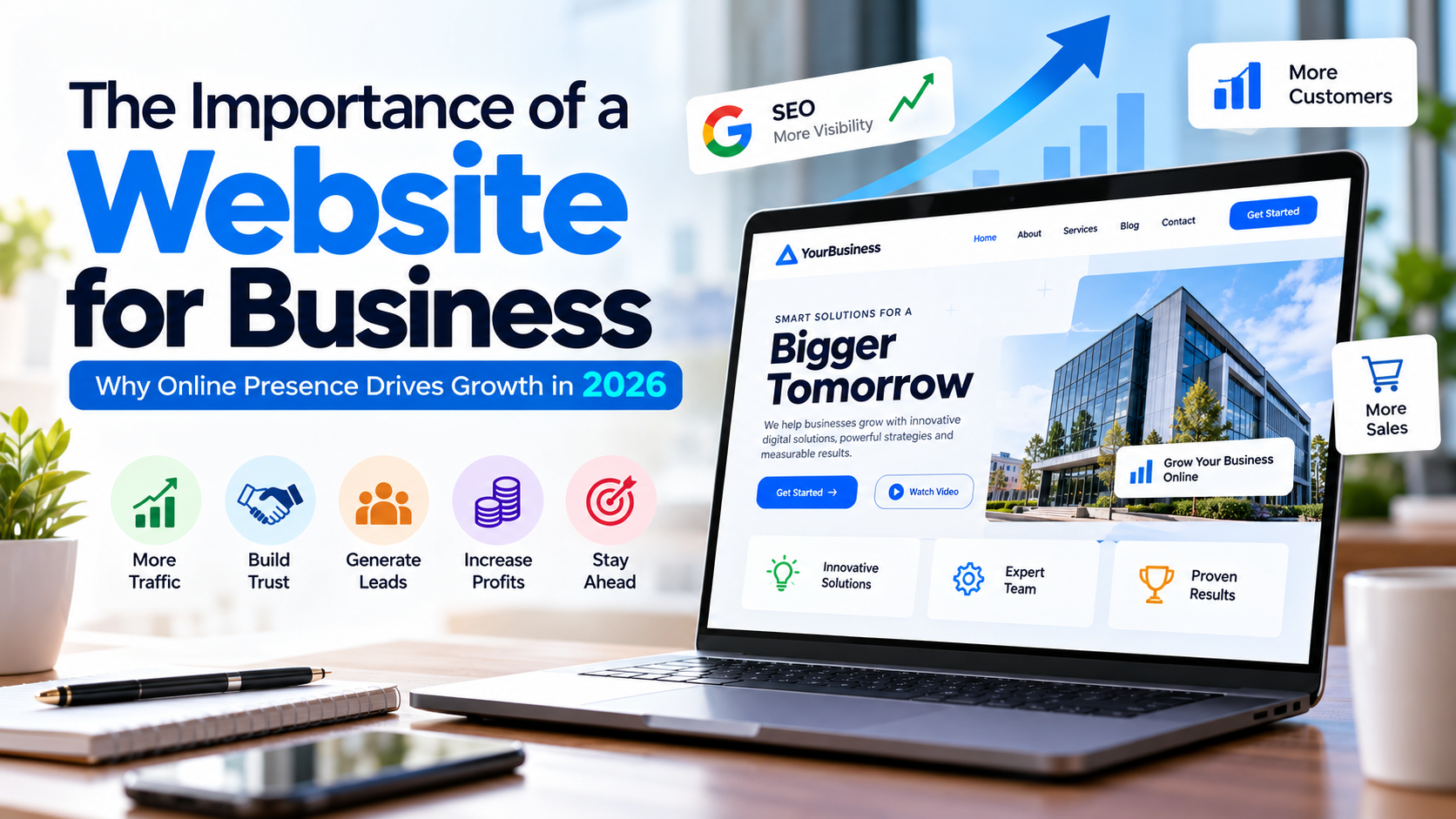
The Importance of a Website for Business: Why Online Presence Drives Growth in 2026
Key Takeaways
Your website is your most cost-effective marketing asset, often generating ROI within 3-6 months.
A website is accessible 24/7, unlike physical locations with limited business hours.
Google's EEAT framework rewards websites that demonstrate experience, expertise, authority, and trustworthiness.
Organic search traffic is free, predictable, and compounds over time as your content gains authority.
Websites now influence how AI search engines like ChatGPT and Google AI Overviews describe your brand.
A professional website is no longer optional; it's the foundation of digital business survival.
What Is a Website, and Why Does It Matter?
Your website is the single most important asset your business can own in the digital economy. A strong website generates free traffic, builds customer trust, converts visitors into leads and sales, and creates a competitive advantage that costs far less than traditional marketing. Businesses without professional websites in 2026 aren't just behind; they're invisible.
This guide explains why websites matter so much, what they actually do for your business, and how to build one that drives measurable results.
What Exactly Is a Website?
A website is a collection of web pages hosted on the internet, accessible through your domain name (like yourbusiness.com). But that technical definition misses the real point. In 2026, your website is:
Your 24/7 sales representative, working while you sleep
Your credibility builder, establishing trust before customers call
Your lead generation engine, capturing prospects automatically
Your search engine asset, bringing free organic traffic
Your customer service hub, answering questions before they're asked
Your competitive moat, differentiating you from rivals
Every other marketing channel flows back to your website. Paid ads send people there. Social media posts link there. Email campaigns direct there. Your website is where actual business happens.
7 Benefits of Having a Business Website
1. Accessibility and Availability That Never Closes
Your physical location closes at 6 PM. Your website never does.
A business website provides round-the-clock access to your information, products, and services. A customer in another timezone browsing at 2 AM can learn about you, make purchases, or submit inquiries without waiting for business hours. This perpetual availability captures sales you would otherwise lose.
According to research on e-commerce behavior, businesses lose 25-30% of potential sales simply by not being accessible when customers want to buy. Your website recovers that revenue.
2. Building Trust Through EEAT Signals
Google's EEAT framework (Experience, Expertise, Authoritativeness, Trustworthiness) has become the cornerstone of search rankings. A professional website demonstrates all four elements:
Experience: Share real client stories, case studies, and results that prove you've delivered before.
Expertise: Publish in-depth guides and thought leadership content written by qualified professionals.
Authoritativeness: Earn backlinks from reputable sources and display media mentions and industry certifications.
Trustworthiness: Display security badges, customer reviews, clear privacy policies, and transparent business practices.
Our website development services prioritize EEAT optimization from day one because Google rewards these signals with higher rankings and users reward them with higher trust.
3. Organic Search Traffic That Grows Over Time
Your website is your SEO asset. With proper optimization, it attracts free, targeted traffic from Google and other search engines.
This organic traffic is fundamentally different from paid traffic:
Zero cost per click, no matter how many people visit
Compounds over time as content ages and gains authority
Brings highly qualified visitors actively searching for your solution
Improves your bottom line every month without additional ad spend
A website optimized for search can generate hundreds or thousands of qualified leads monthly without spending on advertising. For service-based businesses, this creates a predictable sales pipeline.
4. Lead Generation and Conversion Systems
Your website captures interested prospects through strategic conversion points:
Contact forms with compelling value propositions
Email signup boxes offering exclusive resources
Chatbots for immediate engagement and support
Clear calls-to-action guiding visitors toward action
Product inquiry buttons and shopping carts
Scheduling links for consultations
Each conversion point filters interested visitors into your sales pipeline. The better optimized your website, the higher your conversion rate and the more valuable each visitor becomes.
5. Cost-Effective Marketing Compared to Traditional Channels
Compared to print advertising, TV, radio, or continuous paid campaigns, a website is remarkably cost-efficient:
Initial investment: $2,000 to $25,000 depending on complexity
ROI timeline: 3-6 months for most businesses
Monthly costs: 100-500 for hosting and basic maintenance
Longevity: Unlike ads that stop working when you stop paying, your website generates leads indefinitely
For small and medium businesses, a website is often the single most cost-effective way to reach customers at scale.
6. Competitive Advantage in Your Market
If your competitors have professional websites and you don't, they've already won most of the game. But if your website is better optimized, more professional, and more user-friendly than competitors, you've created a competitive advantage.
A superior website helps you stand out in crowded markets, command premium pricing, build customer loyalty through experience, and create a competitive moat your rivals struggle to overcome.
7. Data-Driven Decision Making
Your website collects invaluable data about customer behavior, preferences, and pain points. This data enables:
Better product development based on what customers actually want
More targeted marketing based on visitor behavior
Improved user experience that increases conversion rates
Competitive intelligence about market trends
Identification of customer bottlenecks in your sales process
Businesses using website analytics make better decisions, develop products customers want, and increase profit margins. You're no longer guessing; you're observing customer behavior directly.
How a Website Increases Business Profit
Your website directly contributes to your bottom line through multiple revenue streams and cost-saving mechanisms.
Direct Revenue Generation
E-commerce websites sell products directly to global audiences. Service businesses use websites to book high-ticket consultations and projects. Membership sites create recurring revenue through subscriptions and access fees.
A single client acquired through your website might generate $5,000 to $50,000+ in project value. Scale that across dozens of clients monthly, and your website becomes a serious revenue driver.
Reducing Operational Costs
Websites reduce costs across your business:
Customer self-service through knowledge bases reduces support staff needs
Automated booking eliminates administrative overhead
Digital delivery of products eliminates shipping and production costs
Reduced advertising spend as organic search provides free traffic
These cost reductions directly increase profit margins on every sale.
Increasing Customer Lifetime Value
Your website doesn't just generate one-time sales; it builds lasting customer relationships:
Email lists captured through your website enable repeat sales
Exceptional user experience drives customer referrals
Community features encourage loyalty and reduce churn
Cross-selling and upselling opportunities increase transaction value
The lifetime value of a customer acquired through your website is typically 3-5 times higher than a one-time purchaser.
Premium Positioning
A professional website justifies higher pricing. Customers associate well-built websites with quality and legitimacy, allowing you to charge premium prices and increase profit margins by 30-50%.
How to Build a Website for Business: A Step-by-Step Guide
Step 1: Define Your Goals and Metrics
Before building anything, clarify what success looks like:
Are you generating leads or making direct sales?
What's your target audience and where do they search?
What specific problems do you solve?
How will you differentiate from competitors?
What's your realistic budget?
Different goals require different strategies and platforms.
Step 2: Choose Your Platform Wisely
Popular platforms include:
WordPress: Flexible, SEO-friendly, powers 43% of websites. Best for blogs and custom builds.
Shopify: Purpose-built for e-commerce. Handles payments and inventory seamlessly.
Webflow: Visual builder combining design freedom with technical optimization.
Website Builders: Wix, Squarespace, GoDaddy. Easy for beginners but limited for growth.
For most businesses, WordPress combined with quality hosting provides the best balance of flexibility, SEO capability, and cost-effectiveness. Our WordPress development services help businesses optimize WordPress sites for ranking and conversion.
Step 3: Design for User Experience and Conversion
Your website design directly impacts both rankings and conversions:
Mobile-first design: Over 60% of traffic is mobile. Your site must perform flawlessly on phones.
Fast loading speed: Every second delay reduces conversion by 7%. Optimize images and minimize code.
Clear navigation: Visitors should understand your site structure within 3 clicks.
Trust signals: Display testimonials, case studies, security badges, and certifications prominently.
Step 4: Optimize for Modern Search
Modern search optimization encompasses three layers:
SEO (Traditional Search Engine Optimization): Keyword optimization, technical SEO, link building, content quality. This remains the foundation.
AEO (Answer Engine Optimization): Structure content so AI systems pull your answer as the direct response to user queries.
GEO (Generative Engine Optimization): Get cited by name inside AI-generated responses on Google AI Overviews and ChatGPT.
For all three layers, the foundation is identical: create genuinely helpful, original content demonstrating real expertise. Our SEO services help businesses rank for competitive keywords and appear in AI search results.
Step 5: Implement a Content Strategy
Your website's content should address your customer's entire journey:
Awareness stage: Blog posts answering "what is" and "how does" questions
Consideration stage: In-depth guides comparing solutions
Decision stage: Case studies, pricing, testimonials
Retention stage: Email followups and exclusive resources
Content should be original, detailed, and genuinely helpful rather than surface-level keyword stuffing.
Step 6: Set Up Analytics and Optimize Continuously
Install Google Analytics 4 and monitor these key metrics:
Organic traffic growth: Should increase 20-30% monthly with optimization
Lead generation: Forms submitted, emails captured, calls received
Conversion rate: Percentage of visitors completing desired actions
Customer feedback: Surveys and testimonials about helpfulness
Successful websites evolve continuously based on data. Review analytics monthly and make improvements.
Website Structure That Works
A successful website requires proper organization and essential pages that guide visitors through their journey.
Essential Pages Every Business Website Needs
Every business website needs these essential pages:
Homepage: Your first impression. Communicate who you are and why you're different.
About/Who We Are: Build trust by sharing your story and credentials.
Services/Products: Detailed information with clear benefits and outcomes.
Blog/Resources: Educational content answering customer questions and improving SEO.
Pricing: Transparent pricing builds trust and qualifies leads upfront.
Contact: Multiple ways to reach you: form, phone, email, chat.
Testimonials/Case Studies: Social proof demonstrating real results.
FAQ: Address common objections and questions preemptively.
Our web development team structures client sites following proven information architecture principles to maximize both user experience and search engine visibility.
Measuring Website Success
The right metrics tell you whether your website is working and where to improve.
Traffic Metrics
Organic traffic: Visitors from search engines. Growth indicates improving SEO.
Direct traffic: Visitors typing your URL or from bookmarks. Indicates brand recognition.
Referral traffic: From other websites and social media.
Paid traffic: From advertising campaigns.
Engagement Metrics
Average session duration: How long visitors spend on your site. Higher is better.
Bounce rate: Percentage of visitors who leave without interacting. Lower is better.
Pages per session: How many pages visitors view.
Conversion Metrics (Most Important)
Conversion rate: Percentage completing your desired action (contact, purchase, signup).
Cost per lead: Total marketing spend divided by leads generated.
Cost per sale: Total marketing spend divided by sales generated.
Return on ad spend (ROAS): Revenue from advertising divided by advertising cost.
Focus on conversion metrics because traffic without conversion is just vanity. Revenue is the ultimate metric.
Conclusion: Your Website Is Your Business Foundation
In 2026, the question isn't whether you need a website. That ship sailed years ago. The only question is whether your website is good enough to compete effectively in your market.
A professional, well-optimised website is the foundation of digital business success. It works 24/7, brings customers to you, builds credibility and trust, generates leads and sales, and provides data for better decision-making.
Whether you're building your first website or upgrading an existing one, the fundamentals remain clear: focus on user experience, create genuinely helpful content, optimize for search engines and AI discovery, and continuously measure and improve based on data.
Your website isn't an expense. It's an investment in your business's future. In today's digital marketplace, it's arguably the most important investment you can make.
If you're ready to build or improve your website, our web development and SEO services can help. We've helped hundreds of businesses across the GCC and beyond create websites that actually generate leads and sales.
About AFIC Technest
AFIC Technest is a digital marketing agency based in Jeddah, Saudi Arabia, serving businesses across the GCC, UAE, United States, and United Kingdom. With 8+ years of experience, we specialize in website development, SEO, digital marketing strategy, and creating websites that generate revenue. Our team combines technical expertise with deep understanding of local and international markets.
Learn more: Visit www.afictechnest.com or book a free consultation to discuss your website needs.
Frequently Asked Questions
How much does a professional website cost?
Website costs range from $2,000 to $5,000 for simple sites, $5,000 to $15,000 for professional business sites, $10,000 to $50,000 for e-commerce stores, and $50,000+ for enterprise solutions. Monthly maintenance typically costs 50-500. Most businesses recover their investment within 3-6 months.
How long does it take to see results from a website?
Immediate (weeks 1-4): Website provides 24/7 availability. Short-term (months 1-3): Organic search begins bringing traffic. Medium-term (months 3-6): Consistent visitor growth as content accumulates. Long-term (months 6-12): Peak potential with stable, high-quality organic traffic. Most businesses see positive ROI within 6-12 months.
Should I build my website myself or hire professionals?
Build yourself if you have technical skills, your budget is under $5,000, your website is simple (under 20 pages), and you have significant time availability. Hire professionals if you need to save time, your website is complex, competitive ranking matters for your industry, or you want ongoing optimization. Many successful businesses start DIY and upgrade as they grow.
What's the best way to measure website success?
Track organic traffic growth (should increase 20-30% monthly), lead generation (forms submitted, emails captured, calls), conversion rate (2-5% depending on industry), and customer feedback. Use Google Analytics 4 and Google Search Console to monitor performance.
What's the difference between a website and social media for business growth?
Website: You own it completely. Owned media that builds permanent long-term value. Search engines index it. Social media: Platform owns the relationship. Rented media with short lifespan in feeds. Strategy: Use social to drive traffic to your website where you capture leads and make sales.
Let's Connect
Have a project in mind? Send us a message and we'll get back to you shortly.
Your information is secure and will never be shared with third parties.
Related Articles
Social Media Marketing Strategy in Saudi Arabia: 10 Trends Shaping Businesses in 2026
Plan your social media marketing strategy in Saudi Arabia with 10 trends for 2026, local platform data, influencer rules, and tips from a Jeddah agency.
Custom Web Development Services: What They Include, What They Cost, and How to Choose a Partner in 2026
Compare custom web development services, pricing models, timelines, and vendor checks. A practical 2026 guide for teams in the Gulf, US, and UK.
Top 10 Organic Search Engine Optimization Services, Agencies & Pricing, and How to Choose in Saudi Arabia
Compare the top 10 organic search engine optimization agencies & services in Saudi Arabia for 2026. See pricing, deliverables, and how to pick the right SEO partner.
Top 10 Mobile App Development Companies in 2026: How to Pick the Right Build Partner
Compare the top 10 mobile app development companies in 2026. Get pricing, tech stacks, and expert guidance on choosing the right partner for your app build.
The Convincing Guide to Finding the Best Mobile App Development Company in Saudi Arabia
Compare the top 5 app development companies in Saudi Arabia and the UAE. Find globally trusted agencies with experience in the US, UK, and GCC.
Custom Mobile App Development: The Complete 2026 Guide for Business Leaders
Planning a mobile app? See how custom app development works, what it costs in 2026, and how AFIC Technest builds apps for businesses across the Gulf, US, and UK.
Breaking the SaaS Mold: What Custom Software Development Actually Means for Enterprise Scale
Tired of per-user fees? Learn what custom software development is, compare its true TCO to SaaS, and find the right tech stack to scale your business
Top 10 Custom Software Development Companies in 2026: The CEO’s Complete Guide to Choosing the Right Partner
Discover the top custom software development companies worldwide. Compare the best firms by expertise, pricing & reviews to find your ideal tech partner