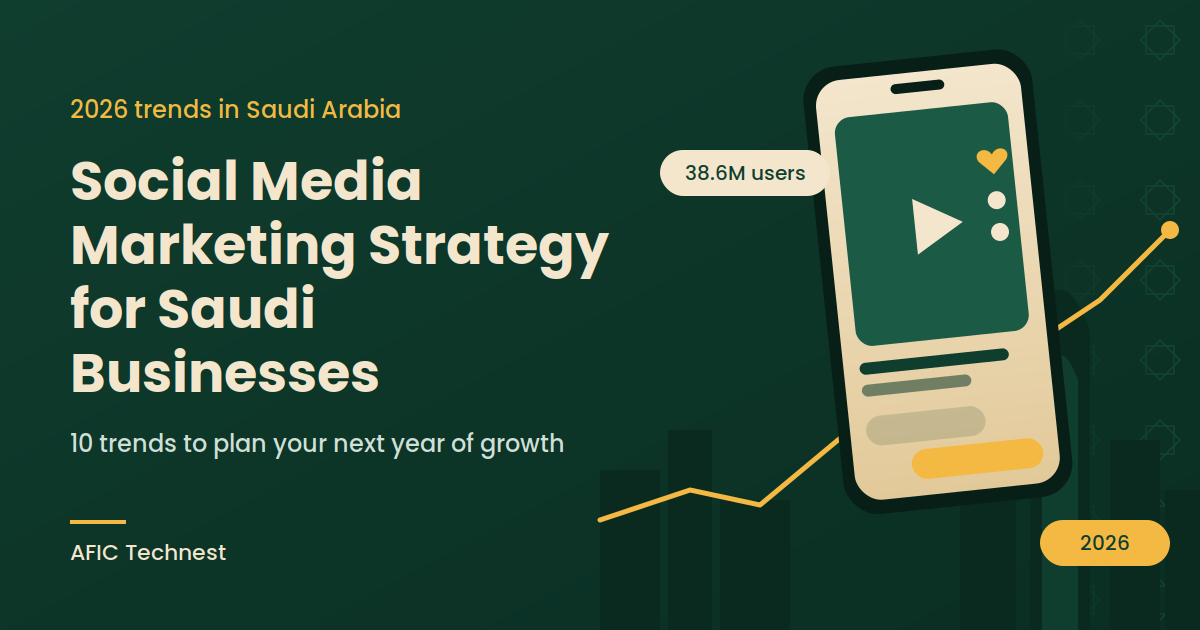
Social Media Marketing Strategy in Saudi Arabia: 10 Trends Shaping Businesses in 2026
Key Takeaways
Social platforms are now search engines. Saudi users look for restaurants, products, and services on TikTok and Snapchat before they open Google.
Arabic content written for a Saudi audience beats translated content every time.
Snapchat is not optional in the Kingdom. It is often the most important platform on the plan.
Paid influencer work requires a licensed creator, so compliance belongs in your plan from day one.
Your social presence now shapes how AI tools like ChatGPT and Google's AI Overviews describe your brand.
The winning metric is revenue, not reach.
A strong social media marketing strategy in Saudi Arabia in 2026 is Arabic-first, video-led, and built for search. It puts Snapchat, TikTok, and Instagram at the center, works with licensed creators, respects local privacy law, and connects every post to a measurable business result. Brands that treat social as a sales and discovery channel, not just a posting schedule, are the ones growing this year.
That's the short version. The longer version is more interesting, because the Saudi market doesn't behave like anywhere else.
Think about the scale for a second. According to DataReportal, Saudi Arabia had 38.6 million social media user identities in October 2025, equal to 111 percent of the total population.
Add a young audience, heavy daily usage, and a government actively pushing digital growth through Vision 2030, and you get one of the most competitive social media markets in the world.
We work with businesses across the Kingdom from our base in Jeddah, and the same question comes up in almost every first meeting: "What should we actually be doing on social media this year?" This guide is our honest answer.
What Is a Social Media Marketing Strategy?
A social media marketing strategy is a documented plan that explains which platforms you will use, who you are trying to reach, what content you will publish, how much you will spend on ads, and how you will measure results. It ties every post and campaign back to a business goal, such as leads, sales, or brand awareness.
Without that plan, most businesses post when they remember to, boost random posts, and wonder why nothing converts. A strategy replaces guesswork with a system.
Social Media Marketing in Saudi Arabia: Key Statistics for 2026
Before choosing trends to follow, it helps to see where Saudi audiences actually spend their time. Here is a quick snapshot from the most recent published data.
Platform | Audience in Saudi Arabia | Why it matters |
33.8 million users (May 2026) | Broad reach, strong for retargeting | |
Snapchat | 25.3 million users (late 2025) | Daily habit for young Saudis |
19.97 million users (May 2026) | Visual discovery and shopping | |
12.0 million members (late 2025) | B2B and professional audiences |
Sources: NapoleonCat for Facebook and Instagram; DataReportal for Snapchat and LinkedIn.
A few things stand out. Internet access is close to universal, with 34.4 million people online at the end of 2025 and penetration at 99.0 percent. The audience is young and highly engaged, too. A 2026 peer-reviewed study by Saudi university researchers found that close to 70 percent of the population is under 35, average daily social media use tops three hours, and Instagram, TikTok, Snapchat, and YouTube lead engagement.
Which Social Media Platforms Matter Most for Saudi Businesses?
Snapchat, TikTok, and Instagram matter most for consumer brands in Saudi Arabia, while LinkedIn leads for B2B. X remains useful for news, public conversation, and customer service, and YouTube works well for longer educational content. The right mix depends on your audience, not on which platform is trending in your feed.
How Is Vision 2030 Shaping Digital Marketing in the Kingdom?
Vision 2030 is speeding up digital adoption by pushing e-commerce, tourism, entertainment, and small business growth. That means more businesses competing for attention online and more consumers comfortable buying through digital channels. You can read more on the official Saudi Vision 2030 website.
How Do You Build a Social Media Marketing Strategy for Saudi Arabia in 2026?
You build a Saudi social media marketing strategy by setting clear business goals, understanding your local audience, choosing the right platforms, creating Arabic-first content, combining paid and organic efforts, tracking results properly, and improving every month. Here is how that looks step by step.
Set business goals and KPIs. Decide whether you want leads, sales, bookings, or awareness, and attach a number to it.
Research your Saudi audience. Look at age, city, dialect, interests, and which apps they use daily.
Choose platforms based on your audience. Two platforms done well beat five done badly.
Build bilingual content pillars. Arabic first, with English support where your audience needs it. Plan three to five recurring themes.
Plan paid and organic together. Organic builds trust. Paid scales what is already working.
Set up tracking and compliance. Install pixels and conversion APIs, confirm PDPL consent, and verify creator licenses.
Test, measure, and optimize monthly. Keep what works, cut what doesn't, and try one new idea each month.
10 Social Media Marketing Trends 2026 Shaping Saudi Businesses
1. Social Search Is Replacing Traditional Search
Saudi users increasingly type what they want straight into TikTok, Snapchat, or Instagram. "Best shawarma in Jeddah" or "abaya shops Riyadh" often starts in a social app now.
Why it matters: If your content isn't findable inside these apps, you are invisible at the exact moment someone is ready to decide.
What to do:
Put your target keywords in captions, on-screen text, and spoken audio, since platforms transcribe it.
Use a mix of Arabic and English hashtags that people actually search.
Treat your profile bio like a mini landing page with clear services and location.
This is where social and search overlap. Our SEO services team now plans keyword research across Google and social platforms together for exactly this reason.
2. AI-Assisted Content With Real Saudi Localization
AI tools make content production faster than ever. The problem is that everyone has them, so AI-only content now looks and sounds the same.
Why it matters: Audiences notice generic content instantly, and search engines reward the opposite. Google's core update guidance keeps pointing site owners toward helpful, reliable content, and after the March and May 2026 core updates, sites with named experts and real depth held up best.
What to do:
Use AI for drafts, research, and variations. Use humans for voice, humor, and dialect.
Write in the dialect your audience speaks. Hejazi, Najdi, and Modern Standard Arabic each land differently.
Have a native Saudi reviewer check every campaign before it goes live.
3. Short-Form Video and Snapchat-First Creative
Vertical video is the default language of Saudi social media, and Snapchat is where much of that attention lives. Snapchat's ad reach in Saudi Arabia equaled 73.6 percent of the local internet user base at the end of 2025.
Why it matters: Content made for a desktop feed and cropped into a vertical frame rarely performs.
What to do:
Hook viewers in the first two seconds.
Shoot natively for vertical, with real people on screen.
Use AR lenses and filters for launches and seasonal campaigns.
Design for sound off with clear Arabic captions.
4. Licensed Influencer Marketing and the Rise of Micro-Creators
Influencer marketing is huge in the Kingdom, and it is regulated. Since 2022, individuals who earn money from advertising or promotional content on social media must hold a Mawthooq license, which costs around SR 15,000 for three years according to Hammad & Al-Mehdar Law Firm. The program is now run by the General Authority for Media Regulation.
What decides whether a creator needs a license is monetization, not follower count. A small creator running paid posts needs one. A huge account sharing purely personal content does not.
Why it matters: Working with an unlicensed creator can expose your brand to penalties and reputational damage.
What to do:
Ask every creator for their Mawthooq license before signing anything.
Test micro and nano creators. Their audiences often trust them more, and the cost per result is usually lower.
Clearly label all paid content as advertising.
5. Social Commerce and Conversational Selling
The journey from "I saw it" to "I bought it" keeps getting shorter. Shoppable posts, in-app checkout, and WhatsApp Business chats let customers buy without leaving the conversation.
Why it matters: Every extra click between discovery and purchase loses customers.
What to do:
Set up product catalogs on Instagram and Snapchat.
Use WhatsApp Business for quick replies, order updates, and follow-ups.
Make sure the page people land on loads fast and works perfectly on mobile.
That last point is where many campaigns quietly fail. Great ads sending traffic to a slow site is money down the drain, which is why we often pair social campaigns with our website development and mobile app development teams. If you are comparing app partners, our guide to the top mobile app development companies is a useful read.
6. Social Signals Now Shape AI Search Answers
This is the trend most businesses haven't noticed yet. When someone asks ChatGPT, Gemini, Perplexity, or Google's AI Overviews to recommend a company, those tools draw on what the web says about you. That includes YouTube videos, LinkedIn posts, reviews, and public discussions.
Why it matters: Your social presence now influences how AI describes your brand, whether you are recommended at all, and which details it gets right or wrong.
What to do:
Keep your brand name, services, and location consistent across every profile.
Publish expert content on YouTube and LinkedIn that answers real customer questions.
Encourage reviews and genuine mentions on trusted platforms.
Connect your social profiles to your website with Organization schema.
We see this as the meeting point of social media and generative engine optimization, and it is a big part of how our digital marketing services are evolving in 2026.
7. LinkedIn Becomes the B2B Growth Channel
With 12 million members in Saudi Arabia, LinkedIn is no longer just a job board. Decision-makers read, comment, and buy there.
Why it matters: B2B buyers want to see expertise before they ever book a call.
What to do:
Build founder and leadership profiles, not only a company page.
Share practical insights, project lessons, and local market data.
Encourage your team to share company content in their own words.
8. Privacy-First Marketing and PDPL Compliance
Saudi Arabia's Personal Data Protection Law, overseen by the Saudi Data and AI Authority, sets clear rules for how businesses collect and use personal data. At the same time, platforms keep limiting third-party tracking.
Why it matters: Sloppy data practices create legal risk and weaker ad targeting.
What to do:
Build first-party data through lead forms, newsletters, and loyalty programs.
Use server-side tracking and platform conversion APIs.
Get clear consent and keep your privacy policy up to date.
The SDAIA website is the official starting point for PDPL guidance.
9. Culturally Timed Campaigns Win Bigger
Saudi social media has its own calendar, and brands that plan around it outperform those that don't.
Moment | Typical timing | Content angle |
Ramadan | Moves with the Hijri calendar | Family, generosity, late-night engagement |
Eid al-Fitr and Eid al-Adha | After Ramadan and during Hajj season | Gifting, celebration, offers |
Saudi Founding Day | February 22 | Heritage and pride |
Saudi National Day | September 23 | National pride, patriotic creative |
Riyadh Season and seasonal events | Varies by year | Entertainment, tourism, experiences |
Plan major campaigns six to eight weeks ahead, and shift posting times during Ramadan, when engagement moves to the evening and late night.
10. Measurement Moves Beyond Vanity Metrics
Likes and followers feel good, but they don't pay salaries. In 2026, Saudi businesses are asking harder questions about what social media actually delivers.
Why it matters: Budgets go to channels that can prove their value.
What to do:
Track leads, cost per acquisition, return on ad spend, and customer lifetime value.
Combine paid and organic data in one dashboard.
Review results monthly and move budget toward what works.
Common Social Media Marketing Mistakes Saudi Businesses Make
We audit a lot of social accounts, and the same problems show up again and again.
Translating instead of localizing. Word-for-word translation misses tone, humor, and cultural references.
Ignoring Snapchat. Many brands copy a Western plan that skips the platform Saudis use most.
Signing unlicensed influencers. Fast and cheap today can become expensive tomorrow.
Chasing followers instead of customers. A smaller engaged audience usually sells more.
Sending ad traffic to a weak website. Slow pages and confusing forms waste good campaigns.
Why Does a Generic Global Strategy Fail in Saudi Arabia?
A global playbook fails in Saudi Arabia because it ignores the language, culture, platform mix, and regulations that make this market unique. Saudi audiences expect content in their own dialect, use platforms differently than Western users, and respond to cultural moments that global calendars miss entirely.
Language alone makes the point. Talkwalker data shows that 98.5 percent of online conversations in the Kingdom happen in Arabic. A campaign built in English and translated at the end is starting from behind.
Case Study: What We Have Learned Working With Saudi Brands
One lesson holds across almost every account we manage: the brands that grow fastest connect social media to everything else. When the ads, the website, the SEO, and the sales follow-up work together, results compound. When they run separately, they leak.
You can learn more about our team and approach here.
How Do You Choose the Right Social Media Marketing Agency in Saudi Arabia?
Choose a social media marketing agency in Saudi Arabia that understands local culture, creates native Arabic content, works only with licensed creators, reports on business results rather than vanity metrics, and can connect social media with your website, SEO, and paid ads. Proven local results matter more than a flashy pitch.
Use this checklist in agency meetings:
Do they have native Arabic copywriters and a Saudi cultural reviewer?
Can they show real results from Saudi or GCC clients?
Do they verify Mawthooq licenses before booking creators?
Will they report on leads and revenue, not just reach?
Can they fix your website or landing pages if those are the bottleneck?
Why Partner With a Digital Marketing Agency in Saudi Arabia?
A full-service digital marketing agency in Saudi Arabia connects social media with SEO, paid ads, and web development, so every channel supports the others instead of competing for budget. You get one team accountable for the whole customer journey, from the first ad view to the final sale.
As a digital marketing agency in Saudi Arabia founded in Makkah and headquartered in Jeddah, AFIC Technest works with businesses across the Kingdom and the wider GCC, as well as brands in the UAE, United States, and United Kingdom entering or expanding in the Saudi market. Our social media marketing services are built to work alongside SEO, web development, and paid ads from day one.
Conclusion: Build Your 2026 Social Media Marketing Strategy Now
Social media in Saudi Arabia is moving fast, but the fundamentals of a winning social media marketing strategy are clear. Speak to your audience in their language. Show up where they search. Work with creators the right way. Protect their data. And measure what actually grows the business.
If you want an honest look at what is working and what isn't on your current accounts, book a free consultation with our team. We will review your channels and send you a clear, practical roadmap for the months ahead.
Frequently Asked Questions About Social Media Marketing in Saudi Arabia
What is the best social media platform for businesses in Saudi Arabia?
It depends on your audience. For consumer brands, Snapchat, TikTok, and Instagram usually deliver the strongest results because young Saudis use them every day. For B2B companies, LinkedIn is the most effective channel. Most businesses see the best results by focusing on two or three platforms that match where their customers already spend time.
Do influencers need a license to advertise in Saudi Arabia?
Yes. Anyone earning money from paid social media promotion in the Kingdom needs a Mawthooq license from the General Authority for Media Regulation. The requirement depends on earning from advertising, not on follower count. Brands should always confirm a creator's license before signing a deal to avoid penalties.
What are the top social media marketing trends for 2026?
The biggest trends in 2026 are social search replacing traditional search for many queries, AI-assisted content with human localization, short-form vertical video, licensed micro-influencer marketing, social commerce, privacy-first data practices, and the growing influence of social content on AI search tools like ChatGPT and Google AI Overviews.
Should Saudi businesses post in Arabic or English?
Arabic should come first for most Saudi audiences, since the vast majority of online conversations in the Kingdom happen in Arabic. English works well as a supporting language for expatriate audiences, B2B buyers, and international customers. The best approach is bilingual content written natively for each language rather than translated.
Why hire a social media marketing agency in Saudi Arabia instead of managing it in-house?
A local agency brings Saudi market knowledge, native Arabic content creation, established creator relationships, and ad experience across several platforms. That usually means faster results and fewer costly mistakes than building an in-house team from scratch. Many businesses combine both, keeping brand ownership in-house while an agency handles strategy, creative, and paid campaigns.
Let's Connect
Have a project in mind? Send us a message and we'll get back to you shortly.
Your information is secure and will never be shared with third parties.
Related Articles
Custom Web Development Services: What They Include, What They Cost, and How to Choose a Partner in 2026
Compare custom web development services, pricing models, timelines, and vendor checks. A practical 2026 guide for teams in the Gulf, US, and UK.
Top 10 Organic Search Engine Optimization Services, Agencies & Pricing, and How to Choose in Saudi Arabia
Compare the top 10 organic search engine optimization agencies & services in Saudi Arabia for 2026. See pricing, deliverables, and how to pick the right SEO partner.
Top 10 Mobile App Development Companies in 2026: How to Pick the Right Build Partner
Compare the top 10 mobile app development companies in 2026. Get pricing, tech stacks, and expert guidance on choosing the right partner for your app build.
The Convincing Guide to Finding the Best Mobile App Development Company in Saudi Arabia
Compare the top 5 app development companies in Saudi Arabia and the UAE. Find globally trusted agencies with experience in the US, UK, and GCC.

Custom Mobile App Development: The Complete 2026 Guide for Business Leaders
Planning a mobile app? See how custom app development works, what it costs in 2026, and how AFIC Technest builds apps for businesses across the Gulf, US, and UK.
Breaking the SaaS Mold: What Custom Software Development Actually Means for Enterprise Scale
Tired of per-user fees? Learn what custom software development is, compare its true TCO to SaaS, and find the right tech stack to scale your business
Top 10 Custom Software Development Companies in 2026: The CEO’s Complete Guide to Choosing the Right Partner
Discover the top custom software development companies worldwide. Compare the best firms by expertise, pricing & reviews to find your ideal tech partner
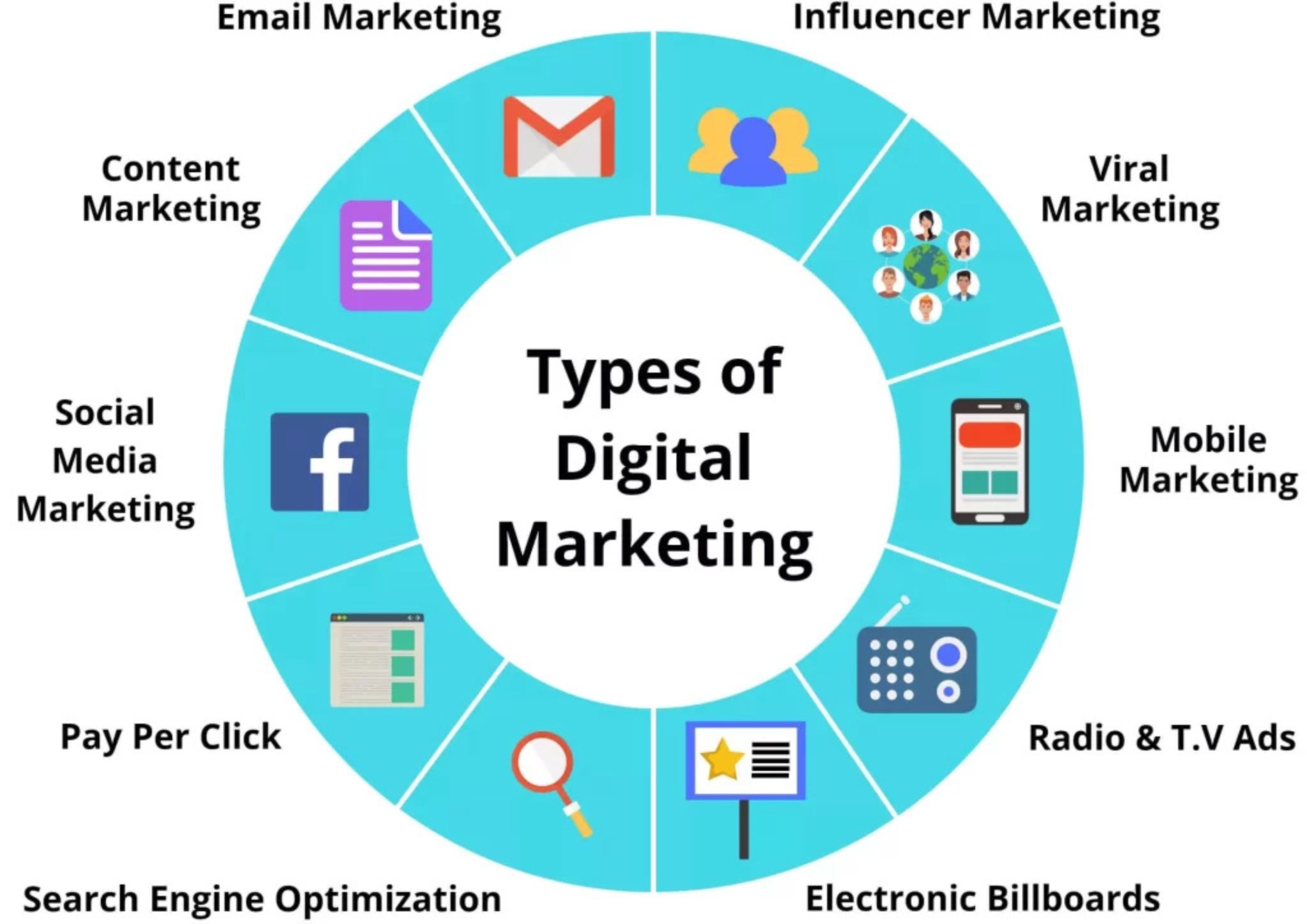
AFIC Technest Software & Digital Marketing Solutions
To empower businesses with innovative technology and effective digital marketing strategies that deliver real growth.