Breaking the SaaS Mold: What Custom Software Development Actually Means for Enterprise Scale
Are you running your business, or are you running it around the limits of your software? Most growing companies are trapped in an expensive rental cycle. They pay high monthly fees for generic apps that only solve 70% of their operational problems. This forces teams to waste time patching the remaining 30% with messy spreadsheets and broken tools.
When your business has to change its workflows just to fit an app, your technology stops helping you grow—it starts holding you back.
True growth happens when you stop renting your software and start owning it. This guide explains exactly what is custom software development in plain English. You will discover how top brands build their own tools to cut out monthly subscription fees, automate their operations, and gain a massive edge over the competition.
1. Defining the Shift: What is Custom Software Development?
To fully grasp how modern enterprises are breaking free from restrictive software setups, we must answer a foundational question: what is custom software development? Unlike Commercial Off-the-Shelf (COTS) applications or standard SaaS platforms designed for a broad, generalized market, custom software is the bespoke process of designing, building, deploying, and maintaining applications tailored explicitly to a single organization’s workflows, data compliance needs, and business goals.
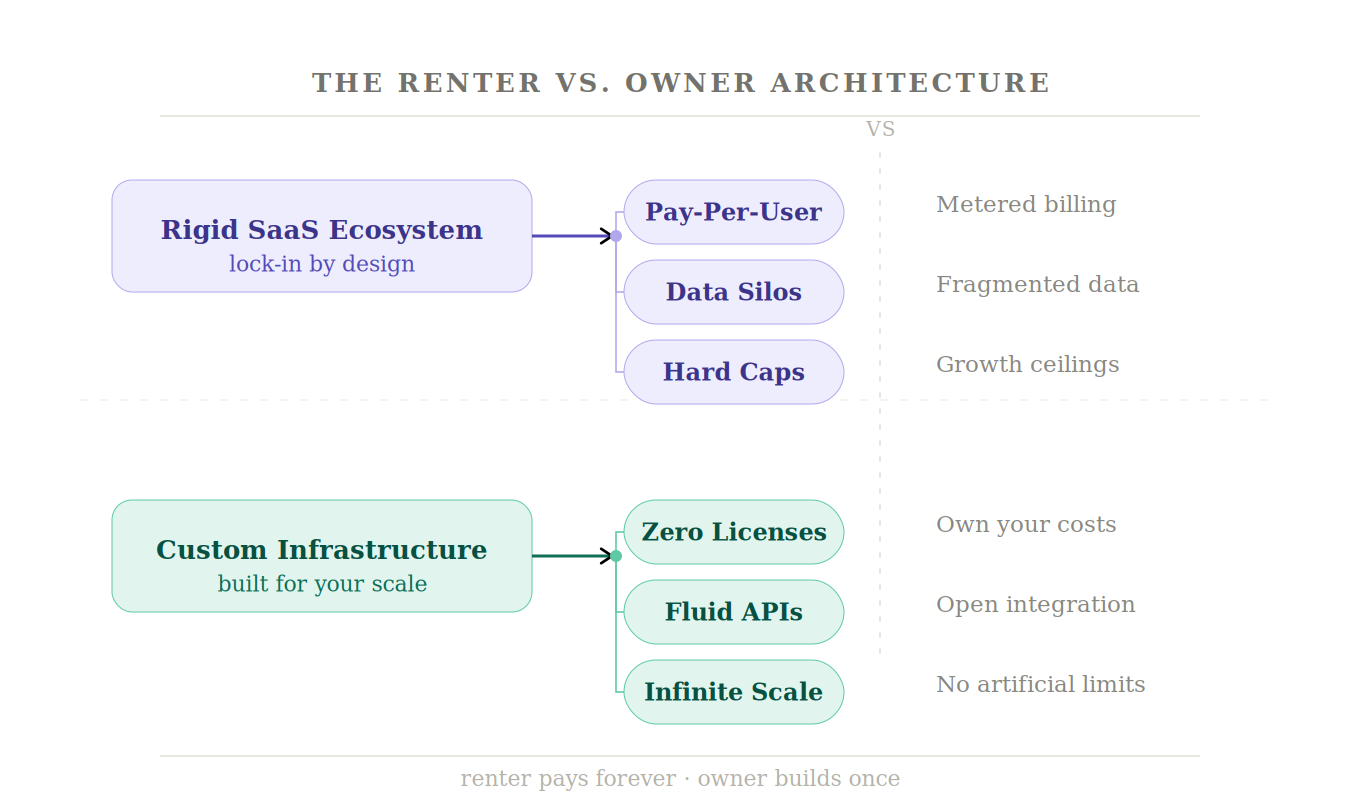 When a business relies entirely on standard SaaS solutions, it essentially rents its operational infrastructure. If the SaaS provider changes their API, adjusts their pricing model, or deprecates a feature your team depends on, your business is left vulnerable.
Partnering with a specialized custom software development company allows you to break this dependency. Instead of modifying your internal business logic to fit a pre-packaged vendor's template, the code is written to match your precise processes. Whether it is an integrated learning management system (LMS), an advanced pipeline for digital marketing data, or a multi-tenant client portal, custom engineering ensures your platform adapts to your team—never the other way around.
2. Breaking the Subscription Cycle: Key Benefits of Tailored Software
Evaluating software infrastructure requires looking past initial setup speeds and analyzing long-term strategic advantages. Examining what are the key benefits of developing custom software through a business lens reveals clear competitive advantages that subscription-based platforms simply cannot match.
Eliminating the "SaaS Tax" and Scaling Friction
Standard software platforms look attractive because of their low cost of entry. However, as an enterprise scales, this model introduces a financial penalty for growth. Adding team members, expanding to new branches, or onboarding clients drives up per-user subscription fees. Custom software completely removes these scaling restrictions. Once built, your application incurs no licensing fees, allowing you to onboard thousands of users without increasing software costs.
Total Data Control and Seamless Architecture
When using multiple SaaS products, your customer and operational data lives in fragmented silos across various external servers. Connecting these tools via generic middleware often causes latency issues, data dropouts, and security gaps. Custom development builds cohesive web solutions where accounting, customer management, and digital marketing data interact natively within a unified database infrastructure.
Building Capital Value via Intellectual Property (IP)
Every dollar spent on subscription platforms is an operational expense that leaves no residual value on your balance sheet. Conversely, funding proprietary code creates a valuable corporate asset. Retaining full intellectual property ownership means your customized tool can eventually be licensed to others, packaged into a spin-off service, or used to significantly boost your firm's market valuation during an acquisition.
3. Financial Realities: The True Cost of Building vs. Renting
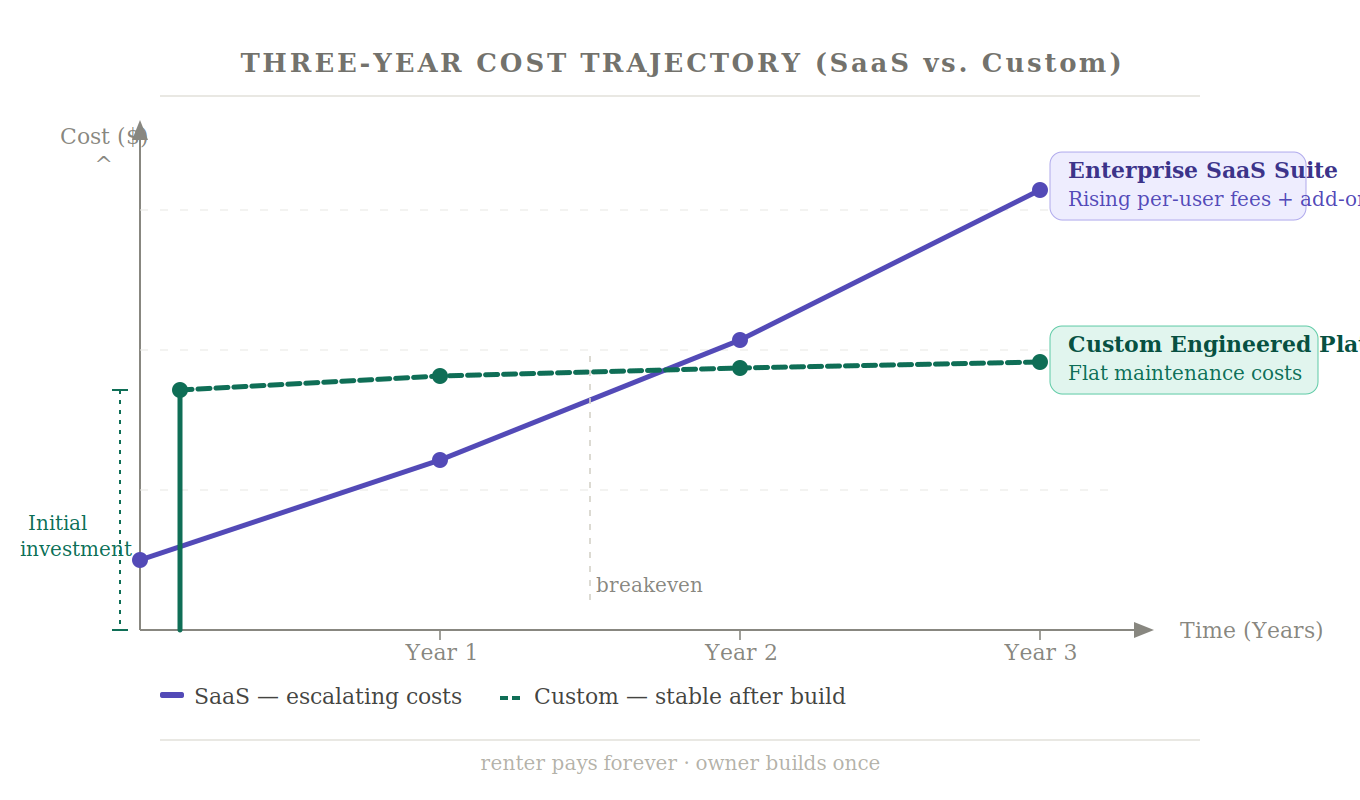
A major concern for decision-makers analyzing software investments is long-term financial predictability. A candid look at how much custom software development costs reveals that while the initial investment is higher than buying a software subscription, the multi-year Total Cost of Ownership (TCO) tells a completely different story.
TCO Comparison: Outgrowing the Subscription Loop
Consider how costs scale over a three-year period for a growing mid-sized business with 100 users requiring specialized workflows:
Three-Year Cost Trajectory (SaaS vs. Custom)
 Investment Tiers by Project Scope
To provide clear guideposts for your technology budget, tailored engineering projects generally fall into three distinct categories:
Project Scope | Architectural Capabilities | Estimated Investment (USD) | Deployment Window |
Minimum Viable Product (MVP) | Single-focus application, fundamental UI/UX, basic API sync, standard relational database. | $25,000 – $50,000 | 2 – 4 Months |
Mid-Market Solution | Multi-role user management, advanced systems integrations, custom UI design, automation layers. | $55,000 – $130,000 | 4 – 7 Months |
Enterprise Infrastructure | Multi-platform synchronization, microservices framework, integrated AI modules, regulatory compliance. | $150,000+ | 8+ Months |
While SaaS software looks cheaper on day one, the compounding costs of seat expansions, premium tier upgrades, and custom integration workarounds quickly add up. Investing in proprietary code turns an unpredictable monthly expense into a stable capital asset.
4. Modern Intelligence: Custom Software Development with AI
Many off-the-shelf software tools have rushed to add generic AI features, which often amount to little more than basic wrappers around public APIs. Utilizing custom software development with AI means building intelligent models directly into your company's core architecture, ensuring your data remains private and highly functional.
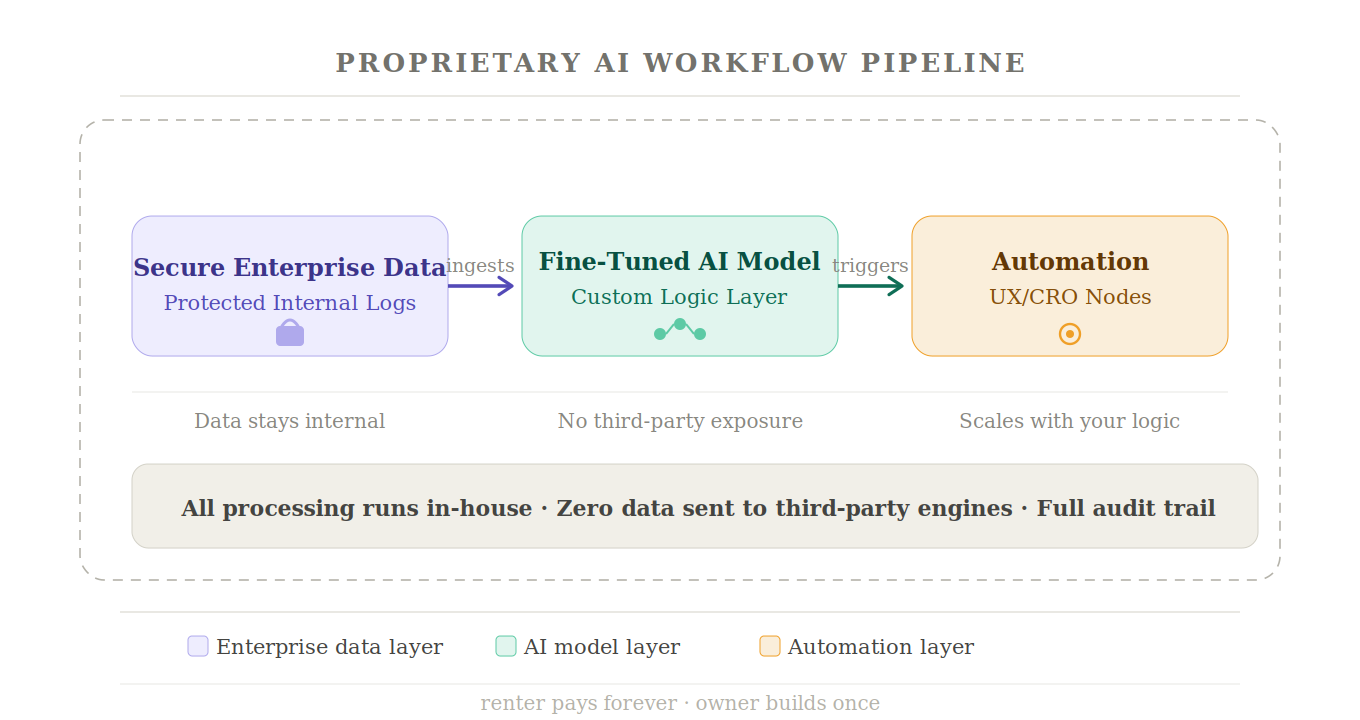 Instead of sending sensitive customer data to third-party software engines, custom AI architecture keeps your processing securely in-house. For example, an agency handling high-volume social media marketing campaigns can deploy custom machine learning algorithms to evaluate conversion rates across landing pages in real time, automatically adjusting design hierarchies based on user patterns.
By building specialized data pipelines, businesses can automate complex tasks such as predicting customer churn, processing invoices, or generating contextual content variations without relying on external platforms.
5. Technology Selection: Choosing the Right Tools
Building a reliable software product requires an optimized codebase. Decision-makers don't need to write code themselves, but they must understand which platforms offer the best custom software development tools and how to choose the right technology stack for a new custom application.
Industry-Standard Technology Options
Frontend Interfaces: Modern web design relies on tools like React.js, Vue.js, or Next.js to deliver fast, responsive, and dynamic user interfaces that function like desktop apps.
Backend Frameworks: Heavy backend tasks are typically handled by Node.js for handling simultaneous requests, Python (Django/FastAPI) for machine learning and deep data processing, or Go (Golang) for high-efficiency enterprise frameworks.
Scalable Cloud Infrastructure: Modern architectures deploy on cloud systems like Amazon Web Services (AWS) or Google Cloud Platform (GCP) using container systems like Docker to ensure effortless scaling as user demand spikes.
Engineering Insight from the Development Suite
"Choosing a tech stack based purely on what's trending is a fast track to technical debt. The right stack must align with your business goals. If your platform needs real-time data streaming and rapid user scaling, an asynchronous Node.js backend is ideal. If you are building deep analytic features, Python is the clear choice. Build for longevity, not hype."
Selecting the right technology stack involves striking a balance between current needs and future development talent pools. Prioritizing well-documented, open-source technologies ensures your platform remains easy to maintain, modify, and upgrade for years to come.
6. Sourcing the Right Partner: From Startups to Enterprise
Moving away from the subscription model requires an engineering partner who understands your business objectives. Sourcing what are custom software development services or selecting a specific custom software development company shouldn't be handled as a transactional purchase—it is a long-term strategic partnership.
How to Choose a Custom Software Development Service for Startups
For fast-moving startups, speed to market is critical. When assessing development services, focus on agencies that use Agile frameworks, offer clear MVP scoping, and have deep experience in product design. The right development partner won't just build whatever you ask for; they will advise you on how to simplify your feature set to launch quickly, gather user feedback, and conserve capital.
Vetting Criteria for Established Enterprises
Full-Spectrum Expertise: Look for teams that seamlessly bridge the gap between creative UI/UX design, website development, and post-launch digital marketing.
Clear Development Pipelines: Ensure the agency uses modern management tools (like Jira, GitHub, or ClickUp) and delivers working software builds on a regular, predictable cadence.
Comprehensive Post-Launch SLAs: Software is a living asset. Your partner must provide structured Service Level Agreements (SLAs) for server management, proactive security updates, and performance tuning.
A high-caliber development team looks beyond the code. They ensure that every feature, database index, and automated workflow directly supports your core operational metrics, user retention numbers, and overall business growth.
Conclusion: Take Ownership of Your Digital Infrastructure
Relying solely on standard SaaS tools can easily limit your company's potential. By moving to custom software development, your business steps away from restrictive licensing and steps into a scalable asset designed entirely around your workflows, security requirements, and long-term vision. Whether you want to streamline operations with integrated AI or build a high-performance web platform, custom applications give you the flexibility to adapt, scale, and lead your industry.
Stop letting generic software choices dictate how you run your business. Partner with an agency that combines technical engineering, intuitive user experience design, and sharp digital marketing strategy.
Build Your Next Competitive Edge with Afic TechNest
At Afic TechNest, we help businesses break out of standard software limits by engineering robust, secure, and scalable custom applications. Our team works closely with you to understand your operational challenges and build custom code that drives actual business results.
Ready to move past generic subscriptions and take full control of your digital infrastructure? Explore our specialized development services at afictechnest.com and book a technical strategy consultation with our engineering team today.
Let's Connect
Have a project in mind? Send us a message and we'll get back to you shortly.
Your information is secure and will never be shared with third parties.
Related Articles

How to Choose the Right UI UX Design Agency in 2026
Choosing a UI UX design agency? Learn 7 checks on process, portfolio, Arabic RTL and pricing, plus red flags. Book a free call with Afic Technest today.
What Is SEO in Digital Marketing? A Complete Guide to Search Engine Optimization
Learn what is SEO in digital marketing, how search engine optimization works, and how to build an SEO plan for Google, AI answers, and LLMs in 2026.
The Importance of a Website for Business: Why Online Presence Drives Growth in 2026
Discover why websites are critical for business success. Learn 7 key benefits, how websites increase profit, step-by-step build strategy, and FAQs from digital experts.
Social Media Marketing Strategy in Saudi Arabia: 10 Trends Shaping Businesses in 2026
Plan your social media marketing strategy in Saudi Arabia with 10 trends for 2026, local platform data, influencer rules, and tips from a Jeddah agency.
Custom Web Development Services: What They Include, What They Cost, and How to Choose a Partner in 2026
Compare custom web development services, pricing models, timelines, and vendor checks. A practical 2026 guide for teams in the Gulf, US, and UK.
Top 10 Organic Search Engine Optimization Services, Agencies & Pricing, and How to Choose in Saudi Arabia
Compare the top 10 organic search engine optimization agencies & services in Saudi Arabia for 2026. See pricing, deliverables, and how to pick the right SEO partner.
Top 10 Mobile App Development Companies in 2026: How to Pick the Right Build Partner
Compare the top 10 mobile app development companies in 2026. Get pricing, tech stacks, and expert guidance on choosing the right partner for your app build.
The Convincing Guide to Finding the Best Mobile App Development Company in Saudi Arabia
Compare the top 5 app development companies in Saudi Arabia and the UAE. Find globally trusted agencies with experience in the US, UK, and GCC.